
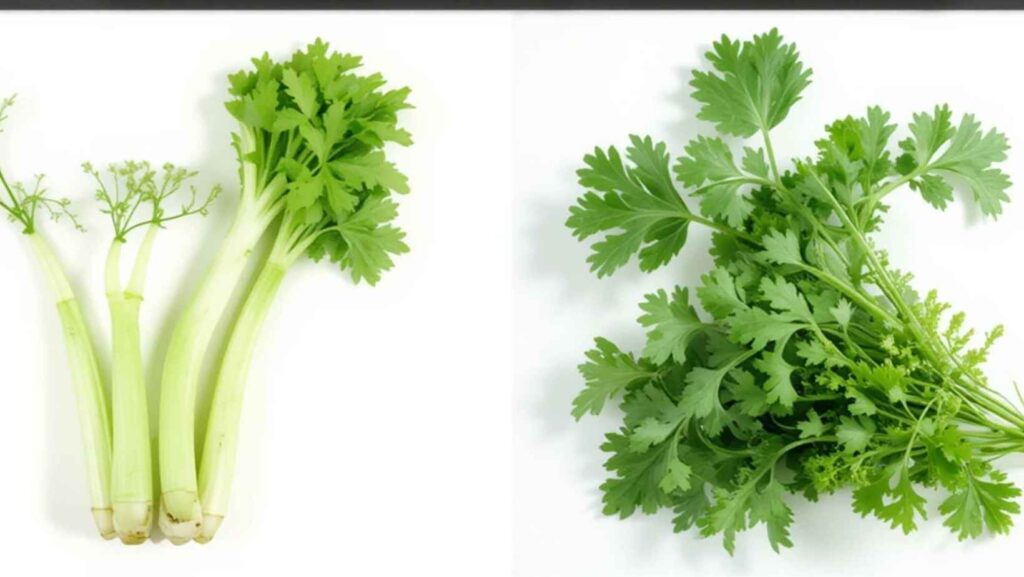
Would you want to know if celery and cilantro are related? According to my knowledge, cilantro is a herb that belongs to the same family as celery and parsley.
Occasionally, particularly when discussing its seeds, it is called “coriander.” Adding herbs, such as cilantro, into a dish during preparation can impart a revitalizing and savory taste without additional sodium.
Herbs are essential for enhancing the essence of a dish. Various herbs can be utilized to improve the flavor and fragrance of cuisine.
Additionally, they are replete with health benefits and offer remedies for various common afflictions.
However, there are a few botanicals that, despite their comparable appearances, are pretty distinct.
Although celery, parsley, and cilantro share a slight visual similarity, they are notably dissimilar in taste, fragrance, and application.
Celery leaves are infused into various dishes to impart a robust flavor, whereas parsley is used as a garnish.
Conversely, cilantro and coriander leaves possess both culinary and medicinal applications. A few distinctions will assist you in differentiating between these prevalent botanicals.
Now, let’s get started.
Are celery and cilantro the same
No, coriander and celery are not the same plant. While coriander, sometimes called cilantro, is a herb with fresh leaves and seeds, celery is a vegetable with crisp stalks and leaves.
They are used in cooking and have unique flavors.
The leaves of cilantro are light green, have varying shapes and sizes, and are slightly fluffy.
Conversely, parsley leaves are darker green and shorter than cilantro leaves. Celery leaves are longer and more oblong than parsley, cilantro, and other herbs.
Is cilantro part of the celery family
The Apiaceae, or family of celery, also includes carrots, celery, celeriac, parsnips, and many of our frequently used herbs, such as parsley, cilantro/coriander, dill, cumin, anise, fennel, caraway, chervil, and lovage.
In old-school terminology, this family was named the Umbelliferae because the seed heads in this family resembled umbrellas.
Its nutritional value could offer several health advantages. The Apiaceae family, which includes parsley, celery, and carrots, has 3,700 species, of which cilantro (Coriandrum sativum L) is a member.
Although the entire plant is edible, locals usually use dried seeds and fresh leaves in their cuisine.
Can cilantro be substituted for celery
While substituting celery leaves with cilantro, also called coriander leaves, one can impart a distinctive and piquant taste to dishes.
Adding a subtle spicy and citrusy undertone to salads and prepared dishes such as stews and soups, it is also an excellent choice for imparting an aromatic quality to salads.
Nevertheless, alternate constituents to celery stems include a number of other substances. Examples of options consist of:
1. Coriander fronds: Coriander leaves, alternatively referred to as cilantro, possess a flavor profile comparable to celery and can be incorporated into soups, stews, and curries as a substitute.
2. Fennel: With a faintly sweet flavor reminiscent of licorice, fennel can serve as a suitable substitute for celery in Indian cuisine. It finds application in curries, salads, and stews.
3. Cumin seeds: In Indian cuisine, cumin seeds with an intense and savory flavor can be substituted for celery. Roasted grains of cumin
What is another name for cilantro
The leaves of cilantro are also referred to as “coriander leaves.” In many areas, cilantro is known as coriander.
However, the name “coriander” can also refer to the dried seeds of the same plant, which are utilized as a spice.
As a result of their crisp and somewhat lemony flavor, the leaves of the coriander plant, also known as cilantro, are frequently utilized in culinary preparations.
There are two popular names for cilantro, an annual plant that grows quickly and has two different names:
The leaves are known as Chinese parsley or cilantro, and the seeds are known as coriander.
What is Celery vs. Cilantro
Celery and cilantro are rich sources of potassium.
• More thiamin, riboflavin, niacin, and pantothenic acid are found in cilantro.
• Compared to celery, cilantro has significantly more iron.
• One excellent source of dietary fiber is cilantro. Calcium, vitamins A, C, and vitamin K are abundant in cilantro.
Calories :
Celery and cilantro have comparable calories: 14 and 23 calories per 100 grams, respectively.
Celery is comparable to cilantro in terms of lipid content; however, it has a lower protein and higher carbohydrate content.
The macronutrient ratio for cilantro, protein, and carbs from calories is 50:50:0, while for celery, it is 33:67:0.
Complete Protein:
The protein contents of celery and cilantro are comparable; celery contains 0.69g, and cilantro has 2.1g per 100 grams.
Final thought
Now, we have established that celery and cilantro are related. Numerous common names identify this plant, including Italian celery, marsh parsley, fragrant parsley, smelly ache, celery, and cilantro.
You might be shocked to learn that cilantro has medical uses in addition to being used as a garnish for cuisine.
Conversely, celery is a herbaceous plant that grows in the winter and is used to improve the taste of salads and soups.